William ALBERT Lowe (1901-1985) was born in Green Turtle Cay, Abaco to William Irwin Lowe and Alice Lowe.
In 1929, he married Annie Estell Curry (1910-1979) daughter of Ledford Ezekiel Curry and Gracie Selina Saunders.
Albert Lowe, known simply as “Pa” by most of his friends, was born in New Plymouth, Green Turtle Cay on February 19th, 1901 to Irwin and Alice Lowe. He attended school in New Plymouth, but spent much of his time with his family at their farm by Sand Banks (near to what is now Treasure Cay) helping on the farm originally started by his great grandparents. Most of the produce from the farm was sold at Norman’s Castle on the west coast of Great Abaco and some also sold in New Plymouth. Albert, along with the rest of his family, would spend other time in New Plymouth when his father was away on sponging voyages, after which they would return to Sand Banks.
At that time the lumber industry was flourishing in Abaco and young Albert went to sea in his early 20’s as a crew member on some of the three masted schooners which transported freight, mainly lumber from the sawmills at Norman’s Castle to Cuba and occasionally to some ports in the United States. During one of these voyages Albert was aboard the Arawak which burned and sank after leaving Jacksonville, Fla., bound for Cross Harbour, Abaco. The passengers and crew were safely rescued by U.S. Coast Guard after escaping in a lifeboat. Albert also turned to the sea for his livelihood as a sponge fisherman. He fished on “The Muds” near Williams’ Cay, Andros aboard the schooner Edna M (owned by the late Capt. Augustus Roberts) and Resolve (owned by the late Harrison Russell).
Later Albert purchased his own boat, a 22 ft. sloop named the J. L. Civic. This was one of the first sailboats built by the late William Albury, the well known boat builder from Man O’ War Cay. With a crew of 5, Albert would take the J. L. Civic to fish the sponge beds around Great Sales Cay. Each sponge fishing trip would last from four to six weeks, after which the fishermen would return to Green Turtle Cay with their catch. Here they soaked the sponges to enable them to get as many as possible into a sack, then these large sacks would be loaded aboard the mailboat to be shipped to Nassau for sale at the Nassau Sponge Exchange.
Often Albert would make the trip to Nassau to sell the sponges himself, as they were sold by private tender and each fisherman wanted to ensure the best possible prices for his sponges.
When disease destroyed the sponge beds in the Bahamas in 1938, Albert, like many others, was forced to find some other means of making a living. About this time shark fishing was the principal industry in Abaco, and Albert engaged in this for awhile. The sharks were caught with nets and chains, and the skins, fins, teeth and livers were sold to local buyers who exported them to the United States. However in the late 1950's, the advent of crawfishing with its greater profits brought an end to shark fishing. Albert did some crawfishing around Green Turtle Cay, but later went as crew on some of the boats such as the M. V. Lindo, and the M. V. Stanba IV, transporting the crawfish from New Plymouth to the Florida market.
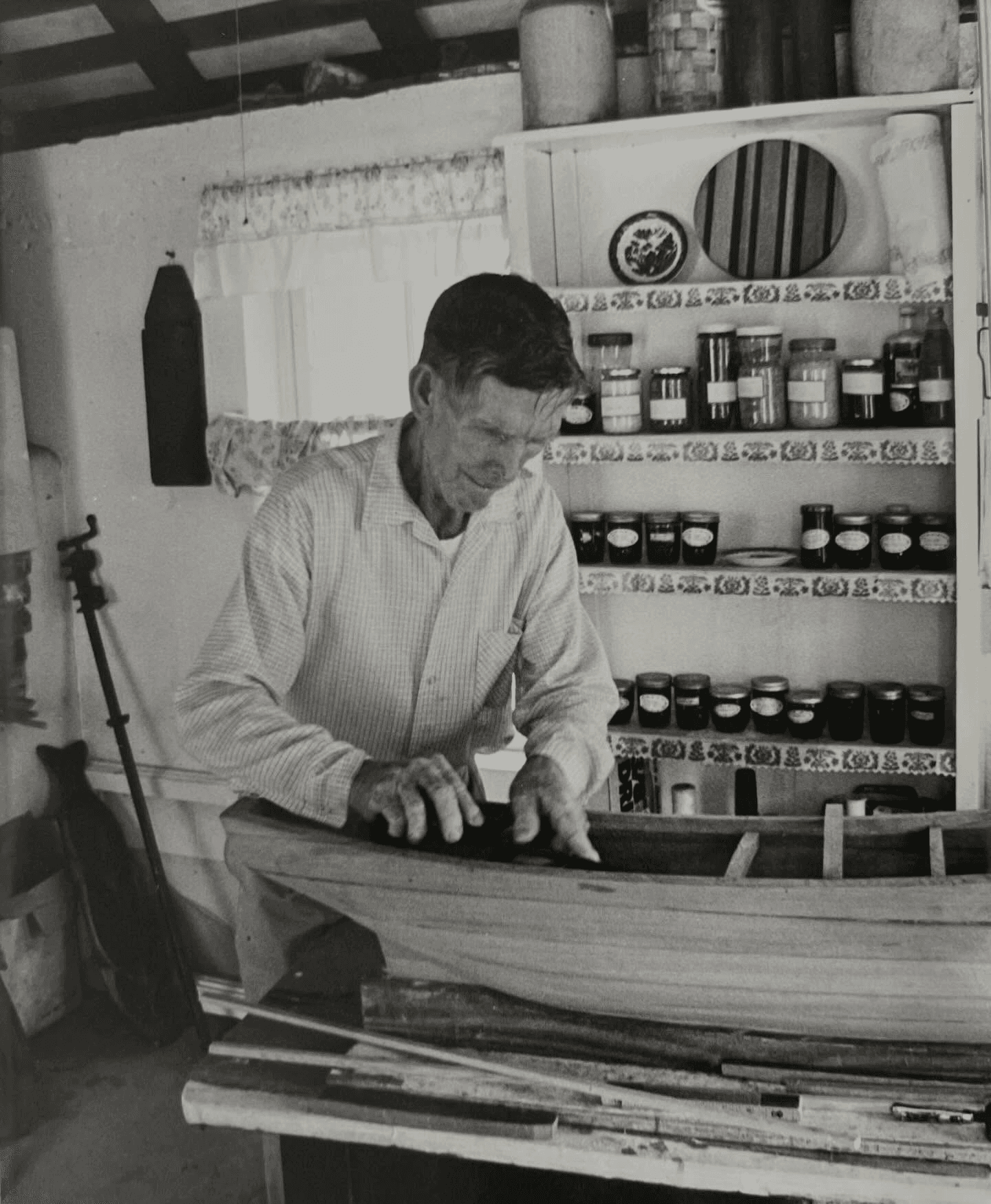
Since his early childhood Albert displayed an interest in woodcarving and throughout his sponging days he built models of the sponging boats and schooners he had sailed on. During the sponging period many of the men would spend their idle hours carving models out of wood. However, Albert showed a natural ability for woodcarving and excelled in this art, improving in workmanship and increasing the size of his models over the years. He had become very versatile, carving various types and sizes of sailing ships and the models on display in this museum were hand carved by him. The four master displayed here is the largest model that Albert has ever crafted and it is fully rigged and completely workable. Albert was paid a great tribute when His Royal Highness Prince Philip expressed admiration for one of his models which was on display in Nassau during the official visit of Her Majesty Queen Elizabeth in 1966. Albert is also recognized as an excellent carpenter and has built a number of native dinghies. All his models are carved without blueprints and are done completely from memory as he gained a knowledge of these ships while sailing on them.
Albert was married to Annie Curry in 1929 and their marriage produced three sons and one daughter. The second son Alton, is the founder of this Museum and he gained fame as the Bahamas' most outstanding artist. Albert played an important role in the establishment of the Museum, giving encouragement and devoting much of his time to restoring the house and preparing his models for exhibit. It is fitting that the Museum is named in his honour. Albert was a soft spoken, gentle and patient man.
His wrinkled and weathered face, his rough and calloused hands are a visible sign of a way of life which he was much a part of, and this painting preserves him for future generations as a symbol of a people who faced the harsh conditions of early island life in the Bahamas and who not only survived, but created a rich and meaningful life for themselves and their descendants.